
How to Invest in Dow Jones?
Author: Victor Gryazin

Dear Clients and Partners,
The Dow Jones Industrial Average is one of the oldest and most famous stock indices over the globe. It is included in the top-three US indices and boasts the best capitalization among them. In this overview, I will demonstrate to you the structure of Dow Jones and give some advice on investing in it.
History of Dow Jones
The DJIA was created in 1896 by a journalist, editor of the famous Wall Street Journal Charles Henry Dow alongside his business partner Edward Davis Jones. Charles Dow used the average for tracking the stock dynamics of US leading companies with high revenue. Initially, the index consisted mostly of industrial companies producing and selling oil, gas, sugar, tobacco, cotton, etc.
The index has changed several times. In 1916, the list of companies was extended to 20, in 1928 – to 30, and this is the number of companies it includes now. During the Great Depression of the 1930s, the list has been reshuffled because many companies went bankrupt. In 1932, 8 members of the index were replaced by such companies as Coca Cola, the Procter&Gamble Company, etc.
The calculation formula of the index was also updated. When the DJIA was created, it showed just the arithmetical mean of those 12 stocks it contained. Today, we use the Dow correction factor that accounts for structural changes in the companies.
Ways to invest in Dow Jones
The DJIA is a popular high-liquidity asset for trading and investing. For the latter, you can use various financial instruments depending on your strategy: stocks, options, futures, CFDs, ETFs.
Buying stocks from the index
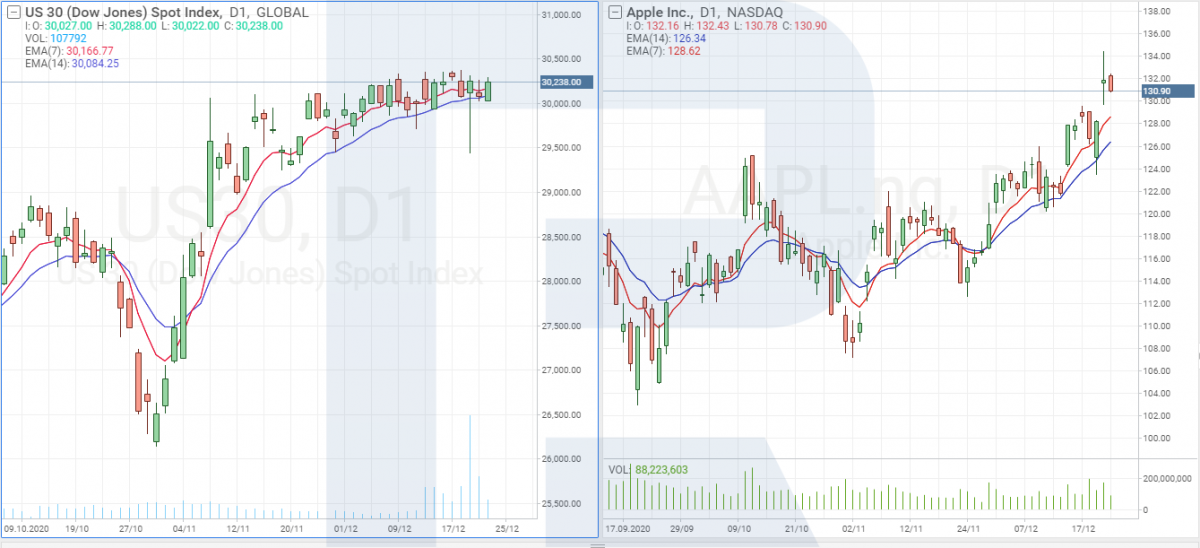
If an investor decides to collect a portfolio of Dow Jones stocks on their own, they will need to buy at least one stock of each company from the index. This will be costly due to the price of certain stocks from the index. Moreover, you will have to watch the market constantly, re-balancing your investment portfolio. The positive side of this investment option is that you will also have your dividends paid to you.
Futures and options
Futures and options are standardized stock derivatives for the DJIA. Buying them can be interpreted as a trade with a whole portfolio of stocks from the index. Note that you do not get your stocks for real, only contracts for them.
Derivatives let experienced investors use complex strategies with different combinations of futures and options. As a rule, these instruments are used for rather short-term investments – six to twelve months. Long-term investments require changing contracts that are expiring for new ones, which might deteriorate your overall result.
Closing thoughts
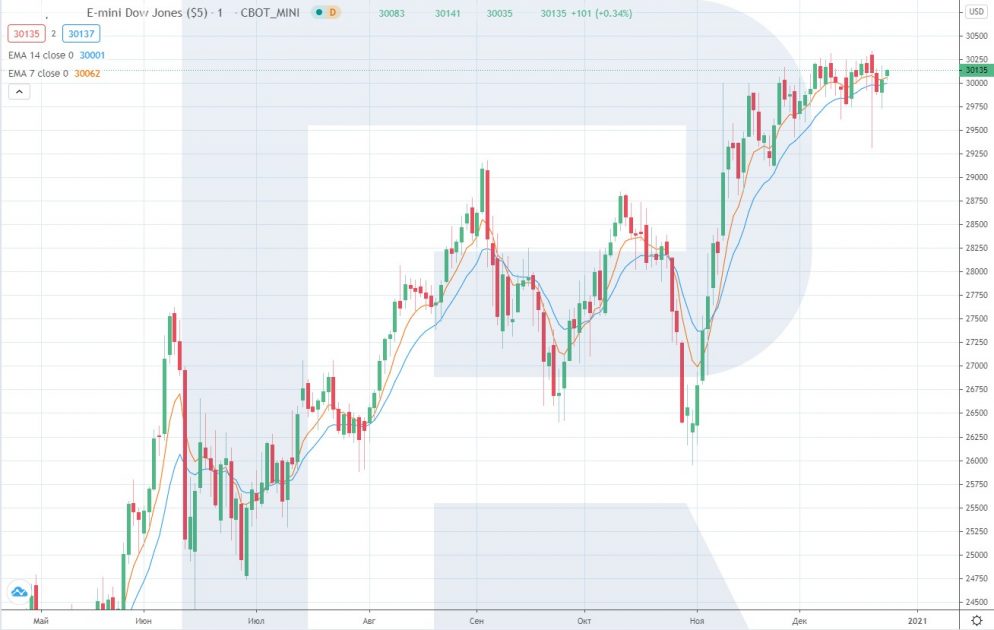
The DJIA includes the stocks of the US 30 leading companies. It does not only identify the economic situation in the country but is also a popular investment instrument. Thanks to various financial instruments (stocks, futures, ETFs, options), you can use various strategies with the DJIA. The choice is yours, just never forget about risks.
Read more at R Blog - RoboForex
Sincerely,
RoboForex team
Author: Victor Gryazin
Dear Clients and Partners,
The Dow Jones Industrial Average is one of the oldest and most famous stock indices over the globe. It is included in the top-three US indices and boasts the best capitalization among them. In this overview, I will demonstrate to you the structure of Dow Jones and give some advice on investing in it.
History of Dow Jones
The DJIA was created in 1896 by a journalist, editor of the famous Wall Street Journal Charles Henry Dow alongside his business partner Edward Davis Jones. Charles Dow used the average for tracking the stock dynamics of US leading companies with high revenue. Initially, the index consisted mostly of industrial companies producing and selling oil, gas, sugar, tobacco, cotton, etc.
The index has changed several times. In 1916, the list of companies was extended to 20, in 1928 – to 30, and this is the number of companies it includes now. During the Great Depression of the 1930s, the list has been reshuffled because many companies went bankrupt. In 1932, 8 members of the index were replaced by such companies as Coca Cola, the Procter&Gamble Company, etc.
The calculation formula of the index was also updated. When the DJIA was created, it showed just the arithmetical mean of those 12 stocks it contained. Today, we use the Dow correction factor that accounts for structural changes in the companies.
Ways to invest in Dow Jones
The DJIA is a popular high-liquidity asset for trading and investing. For the latter, you can use various financial instruments depending on your strategy: stocks, options, futures, CFDs, ETFs.
Buying stocks from the index
If an investor decides to collect a portfolio of Dow Jones stocks on their own, they will need to buy at least one stock of each company from the index. This will be costly due to the price of certain stocks from the index. Moreover, you will have to watch the market constantly, re-balancing your investment portfolio. The positive side of this investment option is that you will also have your dividends paid to you.
Futures and options
Futures and options are standardized stock derivatives for the DJIA. Buying them can be interpreted as a trade with a whole portfolio of stocks from the index. Note that you do not get your stocks for real, only contracts for them.
Derivatives let experienced investors use complex strategies with different combinations of futures and options. As a rule, these instruments are used for rather short-term investments – six to twelve months. Long-term investments require changing contracts that are expiring for new ones, which might deteriorate your overall result.
Closing thoughts
The DJIA includes the stocks of the US 30 leading companies. It does not only identify the economic situation in the country but is also a popular investment instrument. Thanks to various financial instruments (stocks, futures, ETFs, options), you can use various strategies with the DJIA. The choice is yours, just never forget about risks.
Read more at R Blog - RoboForex
Sincerely,
RoboForex team