
Forex Forecast and Cryptocurrencies Forecast for May 04 - 08, 2020
First, a review of last week’s events:
- EUR/USD. Macro indicators paint a completely non-rosy picture of the state of the global economy. However, things in Europe look much worse than in the United States. The European economy has sagged at a record 3.8% in history over the previous quarter and 14.4% over the previous year, while in the United States these figures are just 1.2% and 4.8%, respectively.
Last week, both the ECB and the Fed held meetings. Following the statements made on their results, it can be concluded that both regulators are concerned about the prospects of the crisis deepening, but the Fed can and is taking faster and more effective steps to support its economy than its European counterpart.
In terms of allocations, the ECB's balance sheet has risen by €645 bn since the beginning of March, while the Fed's balance sheet has risen by $2.3 tn. The European Central Bank has lowered the rate for the target long-term lending program LTRO from -0.5% to -1% and announced the launch of the non-target financing program PELTRO at -0.25% but left the key interest rate unchanged at 0%. In addition, investors had expected the ECB to decide on the purchase of bonds of “fallen angels” - securities whose investment rating threatens to fall to “junk” due to the pandemic. But it didn't happen either.
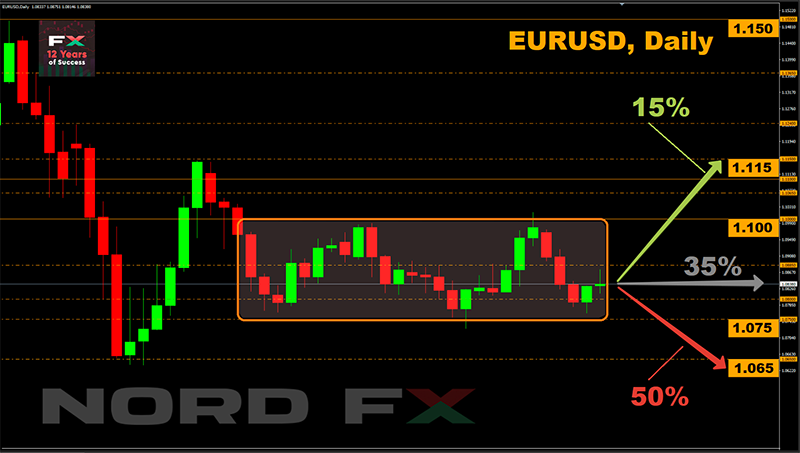
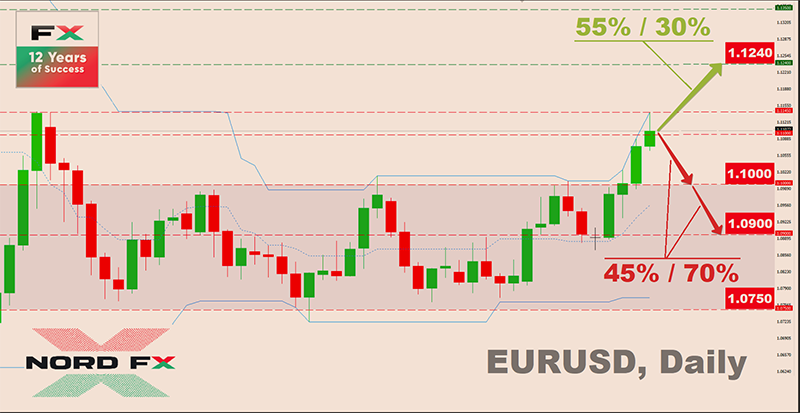
However, the US Federal Reserve also left the interest rate unchanged, which allowed the dollar to stay within the four-week lateral corridor 1.0750-1.1000. After reaching the height of 1.1018, the pair underwent a slight correction and completed the five-day period at 1.0980;
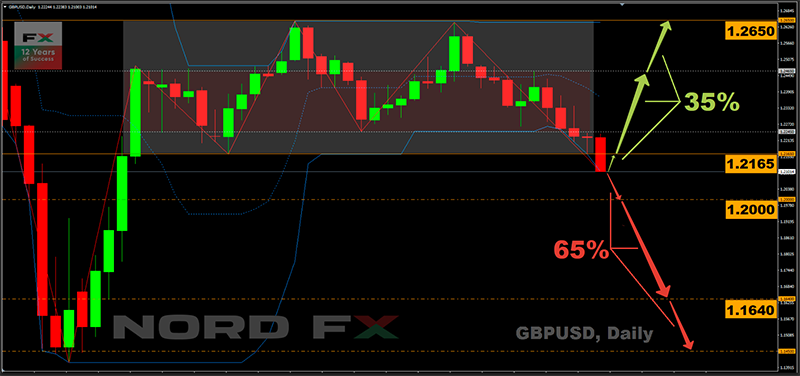
- GBP/USD. In general, the week dynamics of this pair's quotes echoed that of the EUR/USD, however, its correction after the sharp takeoff on Thursday April 30 was significantly stronger.
The pound's weekend sell-off was primarily due to a deteriorating fundamental backdrop in the UK economy. Due to the shutdown of a large number of enterprises, the manufacturing sector PMI fell to a record low of 32.6, which was significantly lower than the critical value of 50.0.
As a result, having started on Monday from the level of 1.2365, the pound finished on Friday in the area of a strong support/resistance zone of 1.2500, losing 135 points to the dollar over the week;
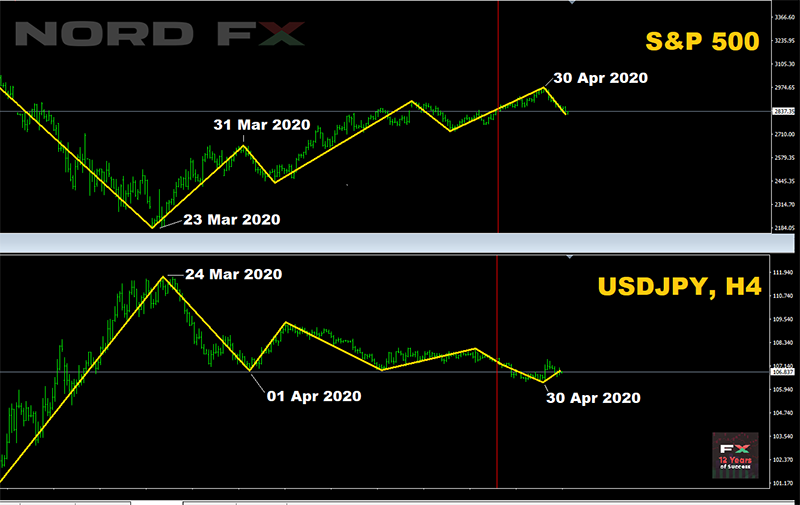
- USD/JPY. With ultra-high volatility caused by the COVID-19 pandemic, the inverse correlation of this pair with the S&P500 and Nikkei225 is particularly noticeable in recent weeks.
As expected by the majority of experts (55%), supported by the vast majority of indicators on H4 and D1 (75-100%), the past week began with another bear attack on the support of 107.00, which is a significant level for the yen for many months and even years. It would seem the breakdown took place and the pair even reached the 106.35 horizon. But the bears failed to consolidate their success. U.S. exchanges closed the last trading day of April with a vast decline. Futures for the S&P500 lost about 3.0%, while Japan's Nikkei225 rolled back from an 8-week high. Following the inverse correlation rule, the USD/JPY pair turned north and returned to where it started on Monday - to the zone 107.40-107.50. The bears made another attempt to break the level of 107.00 on Friday May 1, resulting in the pair finishing the trading session slightly below it — at 106.85;
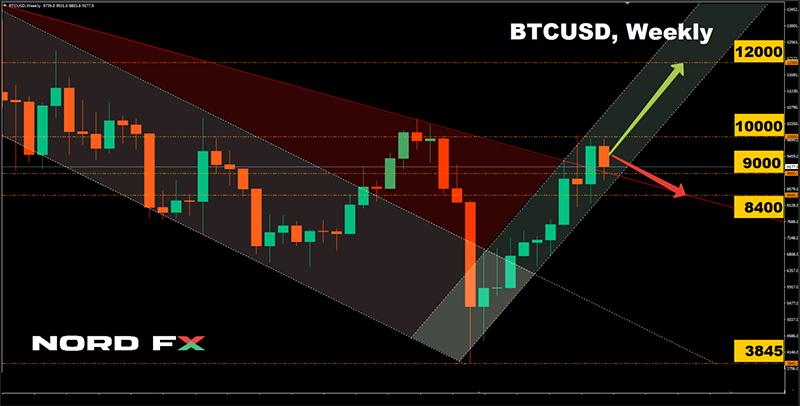
– cryptocurrencies. Halving in the Bitcoin network is getting closer and closer. This event overshadows even what happens in connection with the coronavirus pandemic for crypto-analysts and crypto-traders. The wait is not long, everything should happen on May 12. And, as most experts predicted (65%), the main currency went up in the run-up to the halving, pulling along the entire cryptocurrency market. If the BTC/USD pair was at the level of $7,400 on April 24, it was already close to the height of $9,400 on April 30, showing a gain of 27% over 5 days. The number of bitcoin holders with 0.1 coins in their account reached a record level, exceeding 3 million.
However, apart from the bulls-optimists, of course, there are also bears on the market, pessimists, who believe that the halving is already embedded in the Bitcoin current market price, and therefore there are no reasons for its explosive growth at all. This point of view prevailed by the end of last week, when many traders and miners began to take profits, lowering BTC quotes on April 30 to $8,400.
Then bitcoin rose again and by the evening of Friday May 1 it moved to the $8,700-9,000 zone. The total cryptocurrency market capitalization at the end of the week was $ 247 billion (15% per week), and the Crypto Fear & Greed Index doubled from 20 to 40, finally leaving the red zone of fear and reaching neutral values.
As for such top altcoins as Ethereum (ETH/USD), Ripple (XRP/USD and Litecoin (LTC/USD), they obediently repeated the dynamics of the reference cryptocurrency without ever making any independent movements.
continued below...